



Why AI Will Never Fully Replace Human Marketing Strategy
Fully Automated Marketer
Every few years, marketing goes through a technological identity crisis. First it was automation tools. Then machine learning. Now it’s generative AI. And with each wave, the same prediction comes back louder: “Marketing strategy will soon be fully automated.”
It sounds convincing on the surface. AI can write ads, analyze data, segment audiences, and even predict customer behavior. It feels like strategy is next in line.
But that assumption confuses something important: AI is extremely good at execution, but strategy is not execution. Strategy is direction, judgment, trade-offs, and timing. And those things do not exist in data alone.
The truth is simpler and more uncomfortable for tech enthusiasts: AI will not replace marketing strategy. It will redefine how strategy is executed, tested, and scaled—but the strategic layer itself remains fundamentally human.
To understand why, we need to break marketing down into its actual layers.
What Marketing Strategy Actually Is in the AI Era
Marketing strategy is often misunderstood as “planning campaigns” or “choosing channels.” In reality, it is the system of decisions that defines:
- What a brand is trying to become
- Who it is trying to influence
- How it positions itself in the market
- What it chooses not to do
- How it allocates attention and resources over time
In other words, strategy is not content production. It is constraint design.
AI systems do not naturally operate in constraints unless humans define them. They optimize within boundaries—but they do not create those boundaries in a meaningful, goal-driven way.
This distinction is critical. AI can improve performance inside a system. It cannot define what the system should be.
What AI Can Already Do Extremely Well in Marketing
To be clear, AI is not a minor improvement. It is already reshaping the entire execution layer of marketing.
1. Content Production at Scale
AI can generate:
- Ad copy variations
- Social media posts
- Blog drafts
- Email sequences
- Landing page suggestions
What used to take days now takes minutes. This is not theoretical—it is already the default workflow for many teams.
2. Data Analysis and Pattern Recognition
AI excels at:
- Identifying conversion trends
- Detecting audience segments
- Predicting engagement likelihood
- Flagging performance anomalies
It can process far more data than any human team and surface correlations quickly.
3. Campaign Optimization
Modern marketing platforms already use AI to:
- Adjust bidding strategies
- Optimize ad placements
- Recommend creative improvements
- Run automated A/B tests
This is where AI is strongest: improving existing systems.
4. Workflow Automation
Scheduling, reporting, segmentation, and basic decision routing are increasingly automated. This reduces operational load and increases speed.
But here’s the key limitation: all of this assumes that the strategy is already correct.
AI does not question the direction of the ship. It simply helps the ship move faster.
The Critical Question: What AI Cannot Replace
This is where the misunderstanding happens. People assume that because AI can do more tasks, it can eventually do all tasks.
But marketing strategy contains elements that are not purely computational.
1. Brand Identity Is Not a Data Problem
A brand is not a dataset. It is a position in the mind of a market.
Deciding whether a brand should feel:
- premium or accessible
- rebellious or trustworthy
- technical or emotional
is not something that can be derived purely from analytics. Data can inform direction, but it cannot define identity.
2. Strategy Requires Intent, Not Just Prediction
AI predicts what is likely to happen based on patterns. Strategy decides what should happen, even when it breaks patterns.
Some of the most successful marketing decisions in history were statistically irrational at the time they were made.
3. Cultural Context Is Fluid and Ambiguous
Marketing does not exist in a vacuum. It exists inside culture, timing, and emotion.
AI struggles with:
- sarcasm and subtext
- cultural nuance
- emerging trends with no historical data
- emotional resonance that cannot be quantified
Humans still outperform AI in interpreting meaning, not just signals.
4. Strategic Risk Is a Human Decision
AI is inherently conservative. It optimizes toward known success patterns.
But strategy often requires:
- entering new markets
- redefining positioning
- abandoning successful tactics that no longer align long-term
- betting on uncertain creative direction
These are judgment calls, not optimization tasks.
AI vs Human Marketing Strategy: The Real Difference
The debate is often framed incorrectly as “AI versus humans.” A more accurate model is layered intelligence.
AI strengths:
- Speed
- Scale
- Pattern recognition
- Optimization
- Repetition
Human strengths:
- Meaning
- Direction
- Creativity
- Judgment
- Context
AI answers: “What is most likely to work based on data?”
Humans answer: “What should we do next, given who we want to become?”
That difference is everything.
Marketing Strategy Is Becoming System Design
The biggest shift in modern marketing is not replacement—it is abstraction.
Marketers are moving from execution roles into system design roles.
Instead of manually:
- writing every post
- adjusting every campaign
- analyzing every metric
humans now:
- design workflows
- define automation rules
- set creative constraints
- build decision frameworks
- supervise AI outputs
Strategy is no longer about producing outputs. It is about designing environments where outputs are produced automatically.
This is why modern marketing teams increasingly look like operators of systems rather than creators of individual assets.
Why AI-Driven Marketing Still Needs Human Oversight
Even the most advanced AI systems require guardrails.
Without human oversight:
- brand messaging drifts
- content becomes repetitive
- optimization focuses too heavily on short-term metrics
- creative identity collapses into sameness
AI is excellent at maximizing performance signals. But performance is not always aligned with brand health or long-term positioning.
Humans are required to interpret trade-offs:
- growth vs consistency
- virality vs brand safety
- short-term conversion vs long-term equity
These decisions are not mathematical—they are strategic.
The Risk of Fully AI-Driven Marketing
A fully AI-managed marketing system sounds efficient, but it introduces subtle risks.
1. Homogenization of Brands
If everyone uses similar models trained on similar data, outputs converge. This leads to:
- similar ads
- similar messaging
- similar positioning
In short, marketing becomes generic.
2. Over-Optimization Trap
AI optimizes for what worked before. That creates a bias toward incremental improvements rather than breakthroughs.
But marketing breakthroughs are often non-linear.
3. Loss of Creative Differentiation
When systems prioritize performance over originality, creativity gets filtered out unless it also performs well immediately.
This removes risk-taking from the system.
Will AI Replace Marketing Jobs?
AI will absolutely replace certain marketing tasks and roles:
- basic content production
- repetitive ad management
- entry-level analytics work
- routine campaign setup
But it will not replace strategic roles that involve:
- brand direction
- market positioning
- creative leadership
- decision-making under uncertainty
Instead, it will compress teams. Fewer people will manage larger systems.
However, even this “compression” has a hidden layer most people overlook: account identity architecture.
Modern marketing at scale is no longer just about content or campaigns — it is about managing multiple stable, believable digital identities across platforms.
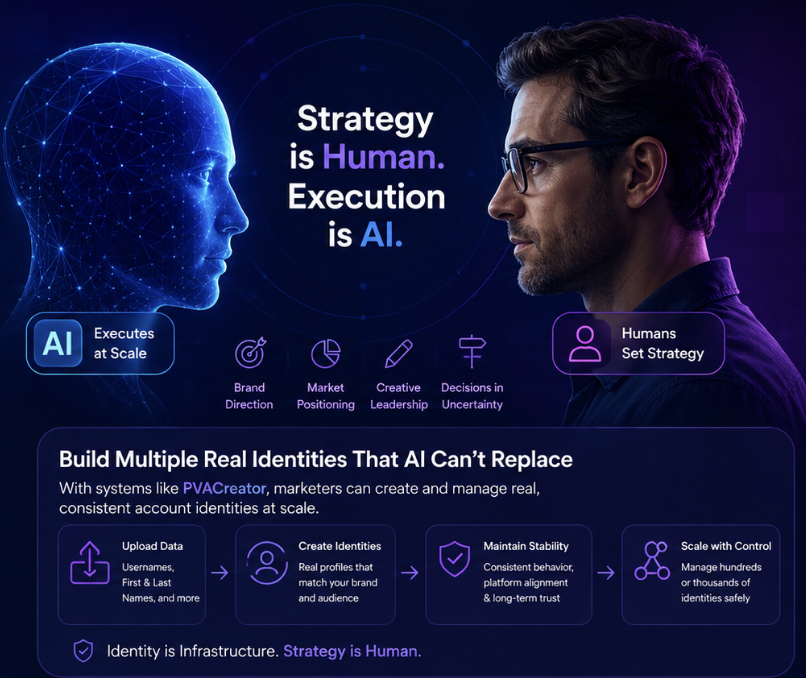
AI can generate content and optimize performance, but it cannot reliably design, maintain, and operationalize real identity structures that behave consistently over time.
This is where human-controlled systems still dominate.
For example, advanced workflows now rely on tools and systems like PVACreator-style identity generation pipelines, where operators build structured account identities at scale. This can include uploading datasets such as:
- customer usernames
- first and last names
- regional identity attributes aligned with brand targeting
These inputs are used to construct realistic account identities that match a brand’s ecosystem and audience behavior patterns.
This is not just automation — it is identity engineering.
And AI alone does not solve this problem well because identity systems require:
- controlled randomness (not pure generation)
- cross-account consistency rules
- platform-specific behavioral alignment
- long-term identity stability
- human validation of “believability”
In other words, AI can assist in content creation, but identity orchestration across multiple accounts is still a strategic human layer.
This is one of the clearest examples of why marketing strategy is not disappearing — it is becoming more system-oriented, not less.
Instead of managing single campaigns, marketers are now designing entire identity
The future marketer is not a content operator. It is a system operator.
The Future of Marketing Strategy in an AI World
The future is not AI replacing strategy. It is AI becoming infrastructure for strategy.
We are moving toward a model where:
- AI handles execution layers
- humans define constraints and goals
- systems run continuously
- strategy evolves in real time
Marketing becomes less about isolated campaigns and more about continuous optimization ecosystems.
In this environment, the most valuable skill is not content creation. It is decision architecture.
Conclusion: Strategy Still Belongs to Humans
AI is transforming marketing faster than almost any previous technology. But transformation is not replacement.
AI does not understand meaning. It does not define purpose. It does not decide identity. It does not take responsibility for direction.
It executes.
Human marketing strategy exists precisely in the space where execution is not enough.
So the real question is not whether AI will replace strategy. The real question is:
Who will learn to design strategy in a world where execution is nearly free?
Because in that world, strategy becomes more important—not less.
Modern marketing strategy is shifting from campaign management to identity-driven system architecture across multiple digital accounts.