



Why Trustpilot Reviews Can Be Misleading: A Closer Look at Rating Systems and Review Integrity
When potential users search for a product, one of the first things they often check is Trustpilot. Reviews are supposed to provide transparency and help people make informed decisions.
However, for many software companies—including PVACreator—the reality is far more complicated.
This article takes a closer look at how Trustpilot’s system works, why its reviews may not always reflect the full picture, and what users should keep in mind when evaluating software based on third-party review platforms.
1. Understanding Trustpilot’s Rating Mechanism
Trustpilot presents itself as an open review platform where customers can freely share their experiences. In theory, reviews are sorted to highlight the “most relevant” or “most helpful” feedback.
In practice, however, several factors influence what users see first:
Recent negative reviews tend to get higher visibility
Review “engagement” (comments, flags, reactions) affects ranking
Platform moderation decisions can remove or hide certain reviews
Businesses without paid plans have limited control over how their profile appears
This means the reviews shown at the top are not always the most representative—they are simply the ones the system prioritizes.
2. Why Trustpilot Reviews May Not Be Fully Reliable
One major concern raised by many businesses is the removal of legitimate, positive reviews.
In our experience:
Genuine users who leave positive feedback may have their reviews flagged or removed
Verification processes can disproportionately affect satisfied customers
Older positive reviews may disappear over time without clear explanation
At the same time, negative reviews—even those that may come from competitors or bad actors—often remain visible.
This creates an imbalance where:
A small number of negative experiences can dominate the overall perception, even if the majority of users are satisfied.
3. The Business Model Behind the Platform
Like many online platforms, Trustpilot operates as a business.
Over time, we have received outreach emails encouraging us to upgrade to paid services. These services typically offer:
Enhanced profile customization
Better visibility and branding
Tools to manage and respond to reviews more effectively
However, after declining these paid options, we observed a noticeable shift:
A significant number of positive reviews were removed
Negative reviews became more prominent
Attempts to contact Trustpilot regarding these issues went unanswered
While we cannot definitively prove intent, the pattern raises valid concerns about whether financial incentives influence how reviews are displayed or moderated.
4. This Isn’t an Isolated Case
This issue is not unique to PVACreator.
Even widely used platforms like ChatGPT have a large number of negative reviews on Trustpilot—despite being used and relied upon by millions of people every day.
This highlights an important behavioral pattern:
Satisfied users rarely leave reviews
Frustrated users are far more likely to post feedback
Even minor issues can trigger disproportionately negative responses
As a result, review platforms often reflect the loudest voices—not the majority experience. 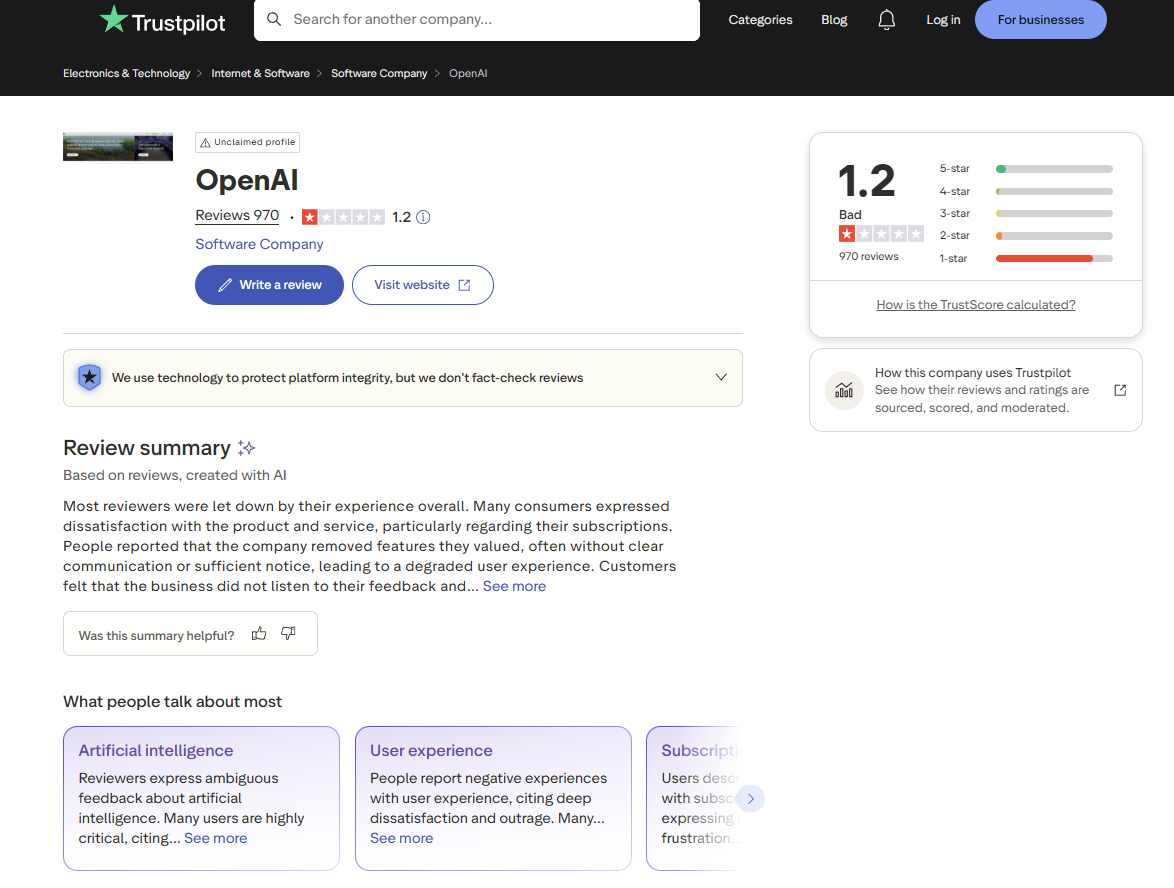
5. The Psychology of Online Reviews
It’s important to understand how users behave online:
People are more motivated to complain than to praise
A single inconvenience can lead to a public negative review
Positive experiences are often taken for granted
Think about it:
Millions of users rely on tools like ChatGPT daily. Yet, if you look at review platforms, you’ll still find a large number of critical reviews.
Does that mean the product is плох? Not necessarily—it means the review system is skewed.
6. What Users Should Do Instead
When evaluating software like PVACreator, we recommend:
Looking beyond a single review platform
Checking multiple sources (forums, communities, direct testimonials)
Considering real-world usage and case studies
Testing the product yourself whenever possible (PVACreator offer free license via telegram channel)
Reviews can be helpful—but they should never be your only decision-making factor.
Conclusion
Trustpilot remains a popular platform, but it is not a neutral reflection of user satisfaction.
Between ranking algorithms, moderation policies, and business incentives, what you see is often a curated version of reality—not the full picture.
At PVACreator, we stand by the performance and reliability of our software. Our users continue to achieve results every day, regardless of how third-party platforms choose to display reviews.
The key takeaway?
Don’t judge a product solely by its top reviews—especially when those reviews may not tell the whole story.