



Why AI Won’t Replace Social Media Automation Tools
Introduction
Recently, we came across a situation that perfectly captures the current misunderstanding around AI.
A potential customer wanted a custom software solution. Instead of starting with requirements or strategy, he used AI to generate code, then handed that code to a development team and expected a complete, working product.
On the surface, it sounds efficient. In reality, it highlights a deeper issue:
AI is being mistaken for a replacement for systems, tools, and expertise.
The same misconception is now spreading into social media automation.
Let’s set the record straight.
The Story: “AI Will Build It for Me”
The customer’s logic was simple:
- “AI can generate code.”
- “Developers can implement it.”
- “So I don’t need to invest in software.”
What actually happened?
- The code lacked structure
- There was no system architecture
- Features didn’t connect properly
- The developers had to rework most of it
In the end, the process became more expensive, slower, and less reliable than using an established platform.
This is not a rare case—it’s becoming increasingly common.
The Core Misunderstanding
AI is incredibly powerful—but it operates within limits.
It can:
- Generate ideas
- Suggest code
- Assist with tasks
But it cannot:
- Build a complete, stable system
- Replace tested infrastructure
- Understand long-term operational needs
In other words:
AI helps you create pieces. It does not replace the system that makes those pieces work together.
Why Social Media Automation Is Different
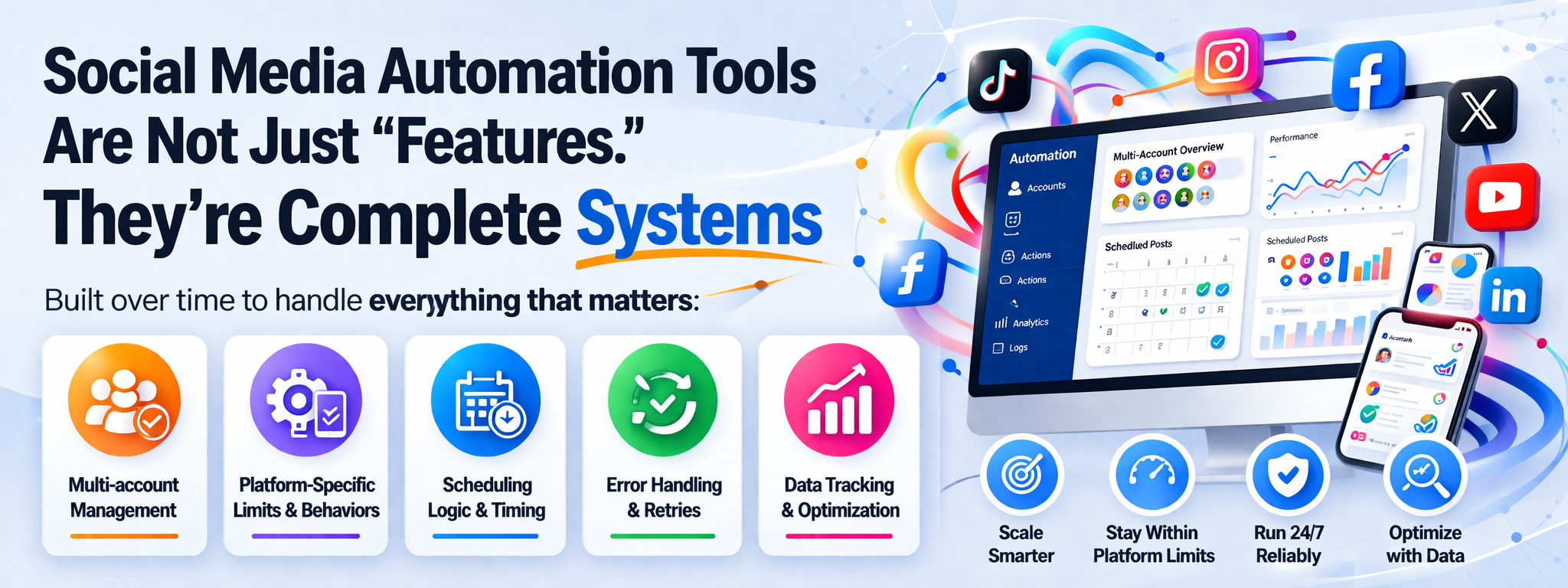
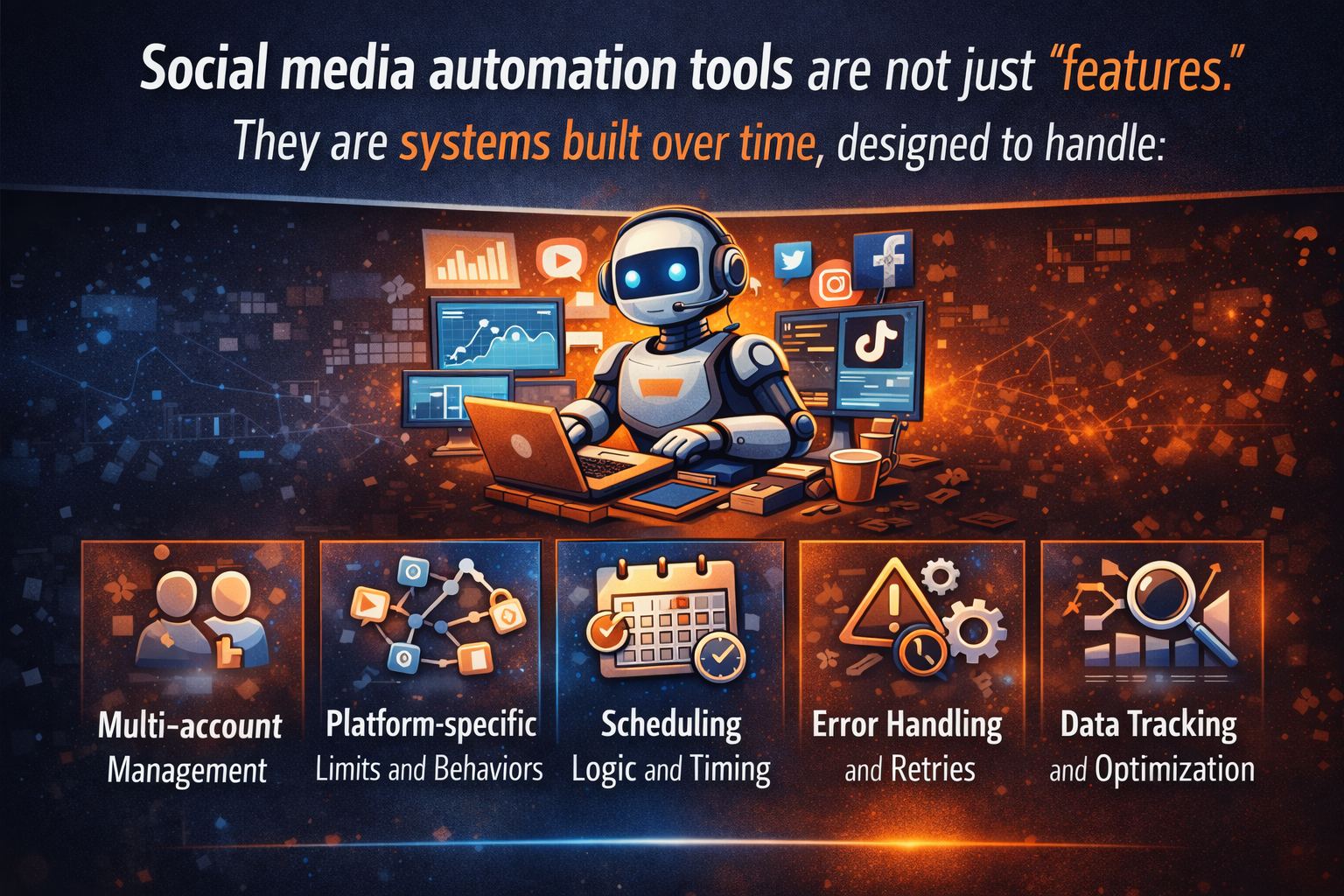
Social media automation tools are not just “features.” They are systems built over time, designed to handle:
- Multi-account management
- Platform-specific limits and behaviors
- Scheduling logic and timing
- Error handling and retries
- Data tracking and optimization
These are not things you casually generate with AI.
They require:
- Continuous updates
- Real-world testing
- Adaptation to platform changes
This is where most “AI-only” approaches fall apart.
The Translator Analogy
Think of AI like a translation tool.
You can translate a sentence instantly.
But in a high-stakes business meeting?
You still need a human interpreter.
Why?
Because:
- Context matters
- Tone matters
- Accuracy matters
The same applies here.
AI can generate outputs, but it doesn’t:
- Understand your business goals
- Adjust based on results
- Take responsibility for outcomes
What AI Actually Does Well
Let’s be clear—AI is not useless. Far from it.
When used correctly, AI becomes a powerful layer on top of automation.
It can:
1. Speed Up Content Creation
Generate captions, hooks, variations, and ideas faster than ever.
2. Enhance Testing
Quickly produce multiple versions of posts for A/B testing.
3. Assist Decision-Making
Analyze patterns and suggest improvements.
4. Reduce Manual Work
Handle repetitive tasks that don’t require human judgment.
What AI Does NOT Replace
This is where expectations need to be realistic.
AI does not replace:
1. Automation Infrastructure
You still need a system that executes actions reliably.
2. Strategy
AI doesn’t know your audience, positioning, or goals.
3. Experience
Knowing what works comes from testing, not guessing.
4. Stability
AI-generated setups are not production-ready systems.
The Real Power: AI + Automation Tools
The winning approach is not choosing one over the other.
It’s combining them.
- Automation tools handle execution, scale, and reliability
- AI enhances creativity, speed, and variation
Together, they create a system that is:
- Efficient
- Scalable
- Adaptable
Separately, they are incomplete.
Why This Matters in 2026
We are entering a phase where:
- AI is everywhere
- Everyone can generate content
- Everyone thinks they can build systems
But the gap between “can start” and “can succeed” is getting wider.
The real advantage now is not access to AI.
It’s:
- Knowing how to use it
- Combining it with the right tools
- Building systems that actually work
Conclusion
AI is not replacing social media automation tools.
It is amplifying them.
The idea that “AI makes software unnecessary” is not just incorrect—it often leads to wasted time, higher costs, and failed setups.
The smarter approach is simple:
Use AI for what it does best.
Use automation tools for what they were built to do.
That’s how real results are achieved.
The funniest part about the story isn’t that the customer used AI.
It’s that they believed the hardest part was writing the code.
In reality, the hardest part has always been—and still is—
building a system that works in the real world.